The amount of punishments handed out to drivers for breaking laws on Northern Irish roads during the past 12 months has been revealed.
The Police Service of Northern Ireland published its latest figures which includes motoring offence statistics from December 1, 2023 to November 30, 2024.
It makes for fascinating reading but what does the data really tell you? Sterling Insurance analysed the report to dig a little deeper behind the headline statements.
Near 20% decrease in the number of punishments given to drivers in Northern Ireland
Police in Northern Ireland detected a total of 34,758 motoring offences, down from 41,767, across the 12-month period. That 17% decrease suggests those behind the wheel are behaving less badly.
However, it doesn’t prove that less people are not offending. It just means fewer drivers have been caught – possibly because the force is having to deal with funding cuts and low officer numbers. Less resources will naturally mean fewer patrols and that allows for more poor behaviour to go unnoticed.
It’s telling that in the last 12 months, the NI Road Safety Partnership detected almost 16 times more speeding offences than the PSNI (79,105). That’s an increase of 13,131 incidents logged in 2022 (the most recent data available) by the same organisation.
Compare that with police records which show speeding offences detected have decreased by 15% (down to 4,840) year-on-year and it tells a very different story.
The number of speed awareness courses being taken has also increased by 6%. This may be due to motorists wishing to avoid penalty points which can cause car insurance premiums to rise.
Males break more motoring laws than females
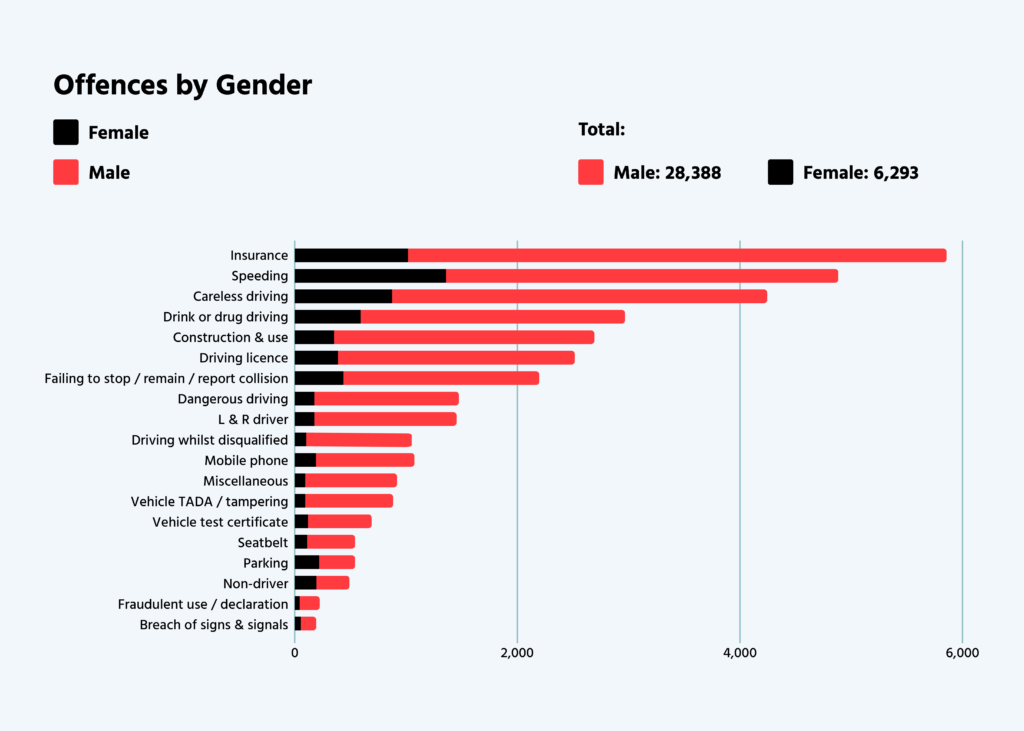
Males have committed almost four out of five misdemeanours in the report, with females only accounting for 18% of offences.
With men four-and-a-half times more likely to fall foul of the law, it’s interesting to look a little further into that information.
There are 654,211 men with a licence, 18,015 more than women, with stats showing the equivalent of approximately one offence for every 23 male licence holders compared with one for every 100 female drivers. These numbers aren’t an entirely accurate representation though given multiple offences may be attributed to one individual, be that for multiple rule breaking (e.g. speeding with no insurance) in one incident or being a repeat offender. Yet it does paint a telling picture and comparison between the genders.
While the cost of car insurance has recently gone down in Northern Ireland thanks to a change in the Ogden rate, it’s well documented that motorists in the country have long been hit hardest when it comes to the price of their premiums. Therefore, unfortunately, it’s no surprise to see such significant amounts of drivers being caught with no insurance.
As the graph shows, both males and females are most likely to be caught speeding, driving without insurance or being charged with careless driving. However, women are more likely to fail to stop/remain/report a collision while men, notoriously risk-takers by nature, are more likely to receive a construction and use offence for being in a vehicle with issues like defective brakes or steering.
Encouragingly, the number of detections of insurance-based offences is down by 22% in the past 12 months. As prices continue to decrease, we expect the amount of people to fall foul of this law to drop once more.
NI motoring offences broken down by location
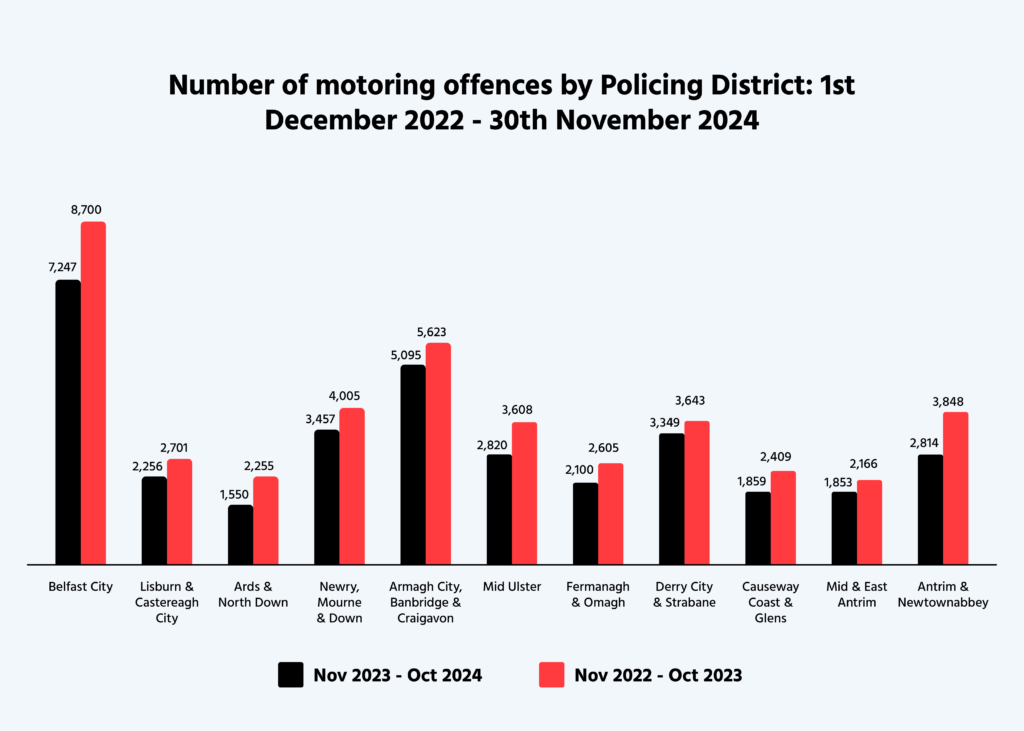
Unsurprisingly, 21% of rule breaking was detected in Belfast City, the country’s capital.
The Armagh City, Banbridge & Craigavon policing district recorded 15% of the total while the least offences were registered by the force in Mid & East Antrim.
All districts have seen a drop in motoring offences over the past 12 months, a fact that is in line with the nationwide picture.
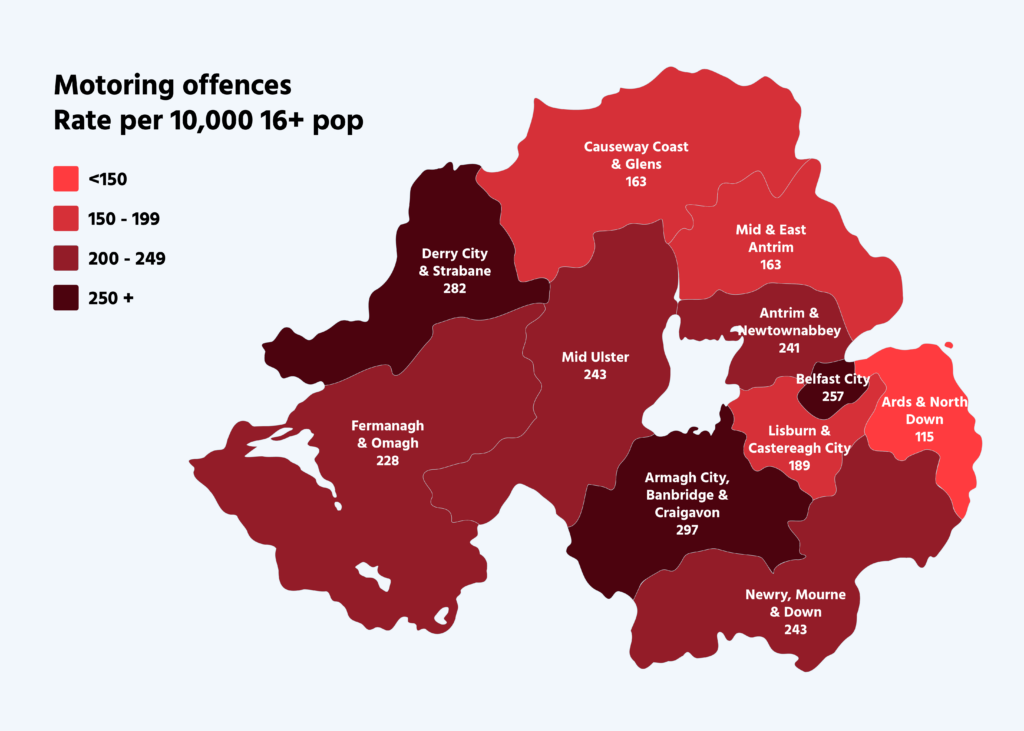
This is best presented in the graphic below which shows the breakdown across the country. It reveals the rate of offences per 10,000 people for those aged 16-plus and provides a better idea of where drivers are being caught most regularly.
Despite the largest incidents of offending, it isn’t Belfast that comes out on top when you break it down per head. That dubious honour belongs to drivers in Armagh, Banbridge and Craigavon with even Derry City & Strabane presenting more offences per head than those in the city.
Other key takeaways from the PSNI report
The 13-page document provides plenty of other insight and analysis, including a month-by-month look at offending.
Some further key takeaways from the PSNI report include:
- In December 2023, drink or drug driving was 20% higher than average, yet people caught for speeding was the lowest
- 30-49-year-olds have accounted for over two-fifths of motoring offences in the last year
- However, digging deeper into that stat shows it’s actually 20-29-year-olds who are most likely to commit an offence based on the number of licensed drivers in NI
- The age-group percentage breakdown of those who have committed a motoring offence (it could be more than one offence per person) was as follows: 6.8% (20-29), 3.3% (30-49), 1.2% (50-69), 0.4% (70+)
- Over a quarter of the offences from 70+ year olds was due to careless driving
- The highest speed recorded by PSNI officers in the latest 12 months was 149mph, on the M2 Foreshore, Belfast
Can I get car insurance if I have committed a motoring offence?
There are a number of driving laws that can be broken – some you may not even be aware of. And at Sterling Insurance, we are aware that mistakes can be made.
Your past doesn’t have to define your future so it’s best to contact us to get a car insurance quote and see what our experts can do. They will find a policy that best suits your needs, circumstances and history so call 0344 381 9990 or request a callback at a time that suits you to find out how they can help.