Drivers in Northern Ireland are facing up to the possibility of being made to travel more slowly on certain roads.
In September 2023, drivers in Wales became the first in the UK to see changes that reduced 30mph speed limits to 20mph in busy areas. With ministers suggesting it would reduce deaths and noise, it has been observed closely by other countries but also created plenty of debate among motorists around how beneficial the implementation has actually been.
Findings have suggested that the reduction in the speed limit has not only made the roads safer, but has reduced the number of speeding convictions and the number of insurance claims too. As a result, the Department for Infrastructure (Dfi) in Northern Ireland completed a three-month consultation to see how drivers felt about the possibility of similar regulations being implemented in their country.
Ahead of the proposed changes, Sterling Insurance decided to provide an even better insight to what life behind the wheel could be like by getting feedback from those who have actually experienced it, namely drivers in Wales.
What was the Northern Ireland speed limit consultation about?
The 14-week consultation, which is part of a wider Road Safety Strategy, was held from January 14 to April 22, 2026, to review whether to bring in 20mph speed limits in targeted areas.
A host of other areas were explored – which included introducing a reduction of the national speed limit from 60mph to 50mph on rural single carriageway roads and to reduce the limit from 70mph to 60mph on dual carriageway roads.
The hope is this will all improve the safety of roads in Northern Ireland. The country currently has 20mph schemes in 20 locations, around 33 advisory zones and approximately 700 roads with traffic-calming measures.
In 2025, the number of motoring offences in Northern Ireland increased by one per cent from 36,837 in 2024 to 37,120 in 2025, the first year-on-year increase since 2018. 12% of motoring offences in 2025 were caused by speeding, with 4,513 detections, according to Police Service of Northern Ireland data.
The DfI are expected to finalise their findings and make decisions over the coming weeks but how do people with experience of living with the changes feel?
Drivers in Wales provide an insight into potential 20mph changes in Northern Ireland
We surveyed around 1,500 drivers in Wales, to understand how the law change has affected their roads and neighbourhoods ahead of the results of Northern Ireland’s consultation being published.
We asked participants several questions about the rules, which have been implemented since September 2023, on how their feelings on the 20mph limits have changed over time, whether roads are less busy, how drivers’ behaviour has changed and if there were a vote tomorrow, would they choose to keep the change or reverse it.
In the first year of the new limits being introduced the number of accidents among Sterling customers living in Wales reduced by 38%, before another 36% drop in the second year. Overall there has been 60% less accidents for customers living in Wales in the two years since the 20mph speed limits were put in place.
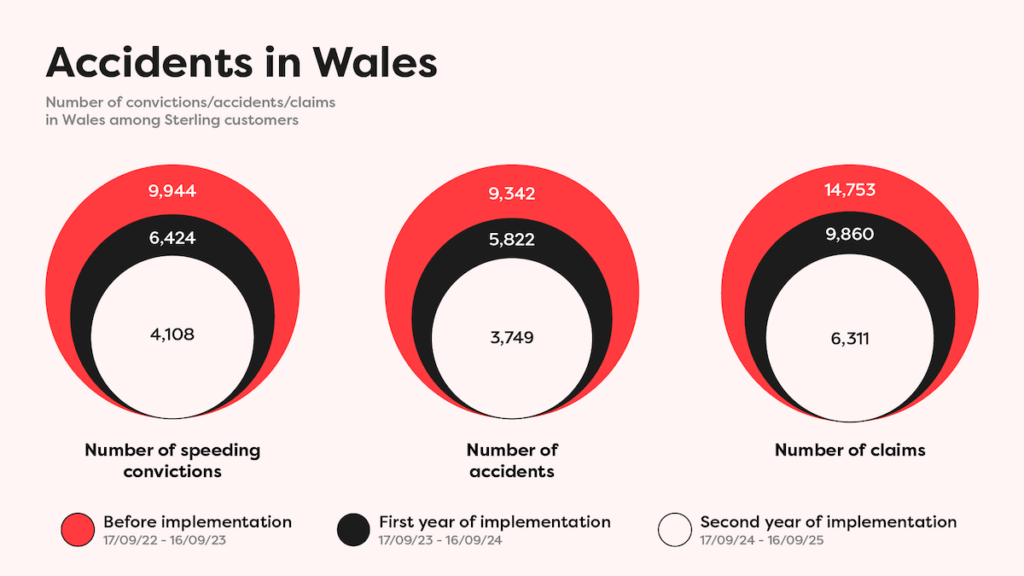
There was also a huge 59% decrease in the number of speeding convictions and 57% less insurance claims were made.
How have feelings in Wales changed over time about the 20mph speed limits?
Despite the benefit of roads being safer, the attitude of drivers in Wales surveyed has not changed drastically over time. We found out that 52% of drivers ‘really disliked’ the idea of the 20mph speed limit change when thinking back to 2023, which has dropped to only 49% as of 2026.
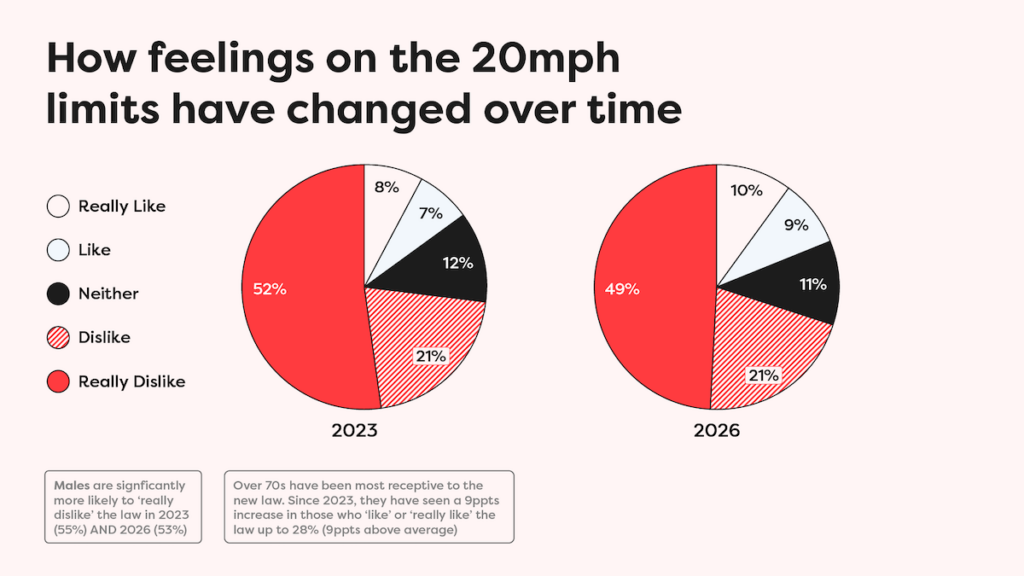
Motorists aged over 70 were the most receptive age demographic to the new law. Since 2023, this group has seen a nine percentage point increase of those who ‘like’ or ‘really like’ the law. However, data did reveal that males, in general across ages, are significantly more likely to ‘really dislike’ the implementation, with 55% in 2023 and 53% in 2026.
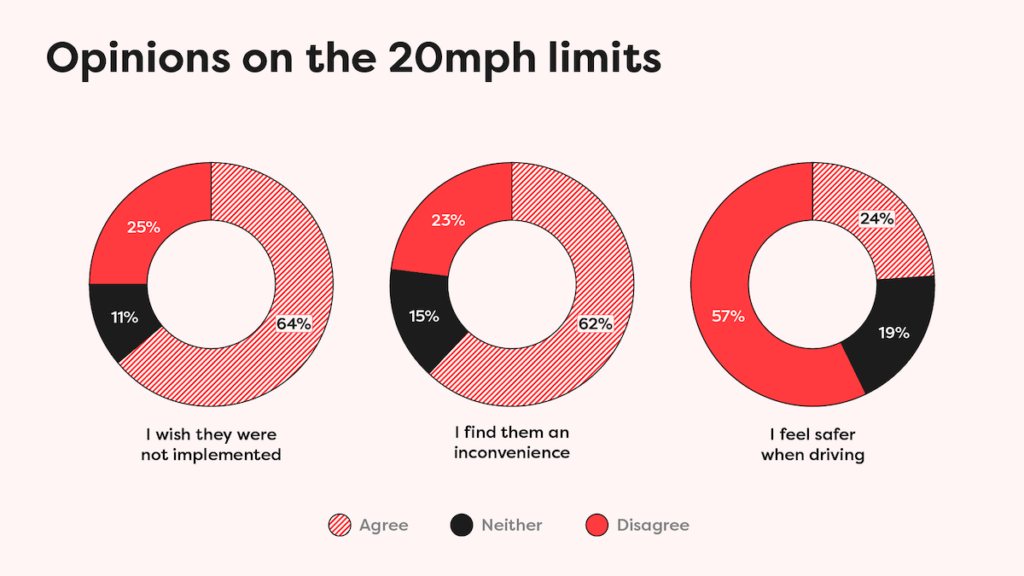
More than three in five also responded to say they wish the 20mph speed limits were not implemented (64%) and 62% felt they are an inconvenience. And despite roads being statistically safer, 57% of drivers surveyed disagreed about feeling safer when driving.
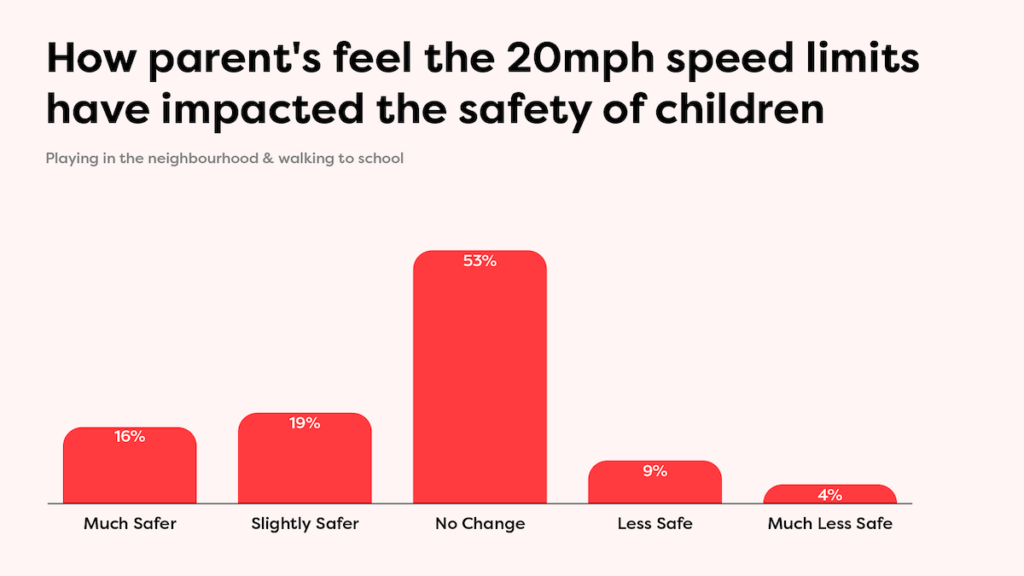
We also asked parents whether they feel roads are more safe now for their children to walk or cycle to school, or being out in the neighbourhood playing. Even though vehicles are supposedly travelling slower, more than half of those who answered felt there has been no change in how they feel.
However, there is a big group of parents who do deem roads to be safer with a combined 35% voting for the two safer options.
Would drivers in Wales vote to change speeds back to 30mph?
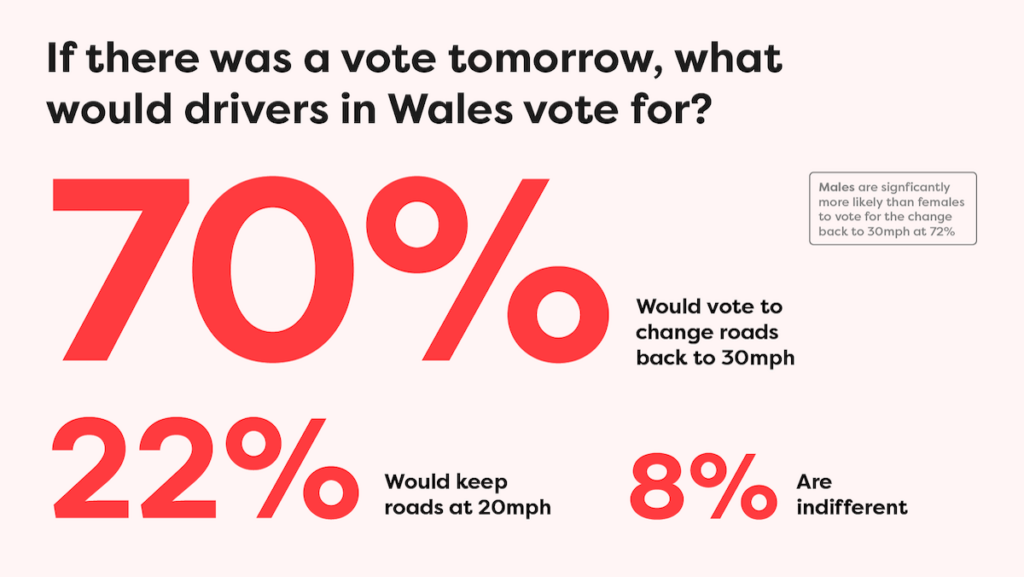
Our survey revealed that seven in ten drivers would vote to change the speed limit back to 30mph tomorrow if there was a vote, with 22% wanting it to remain at 20mph and eight percent who felt indifferent.
Males were significantly more likely to vote for the change back to 30mph at 72%, compared to only 63% of females.
Are roads less busy?
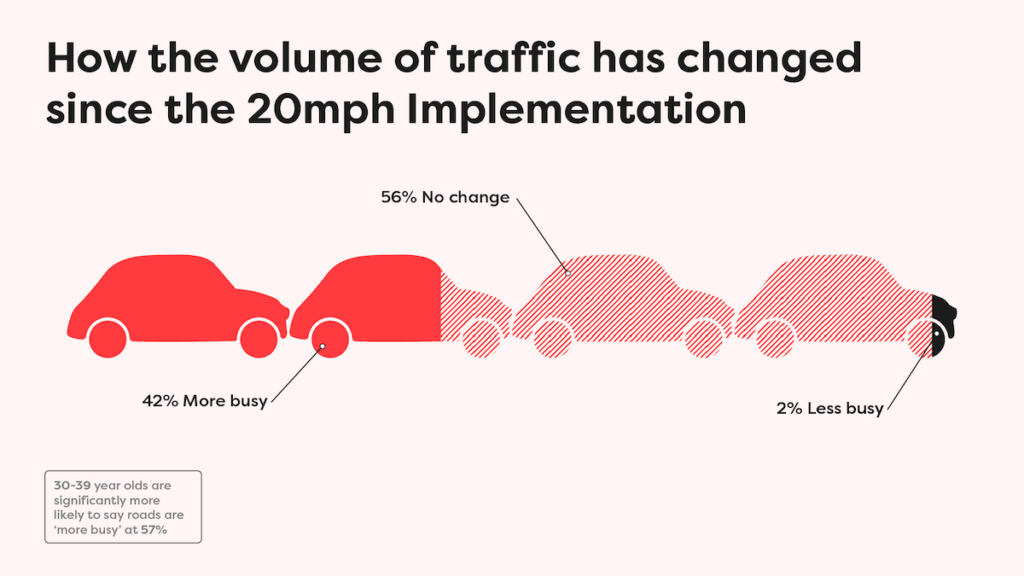
Whether there has been long-term changes in roads in Wales is undecided according to our sample, with 42% saying roads are more busy, whilst 56% said they felt there has been no change.
Those aged between 30 and 39 were 15% more inclined to say roads are ‘more busy’ than before.
Has driver behaviour changed?
A massive 83% of drivers told us they are watching the speedometer more than they were before the law change, whilst 59% said they felt more stressed and anxious when driving. Out of those questioned, males felt the latter more with 61% stating they felt this way compared to 52% of females feeling more stressed/anxious.
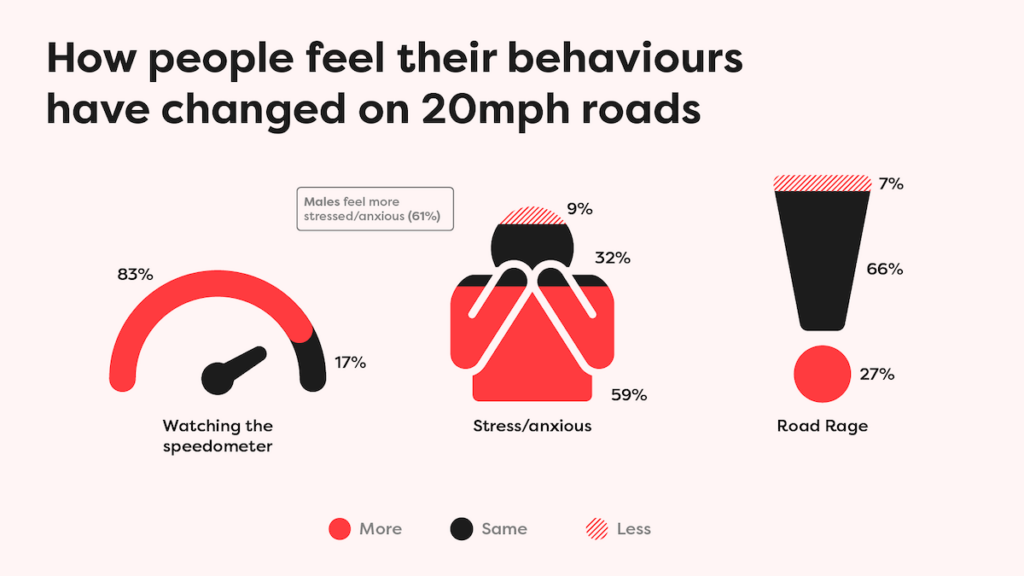
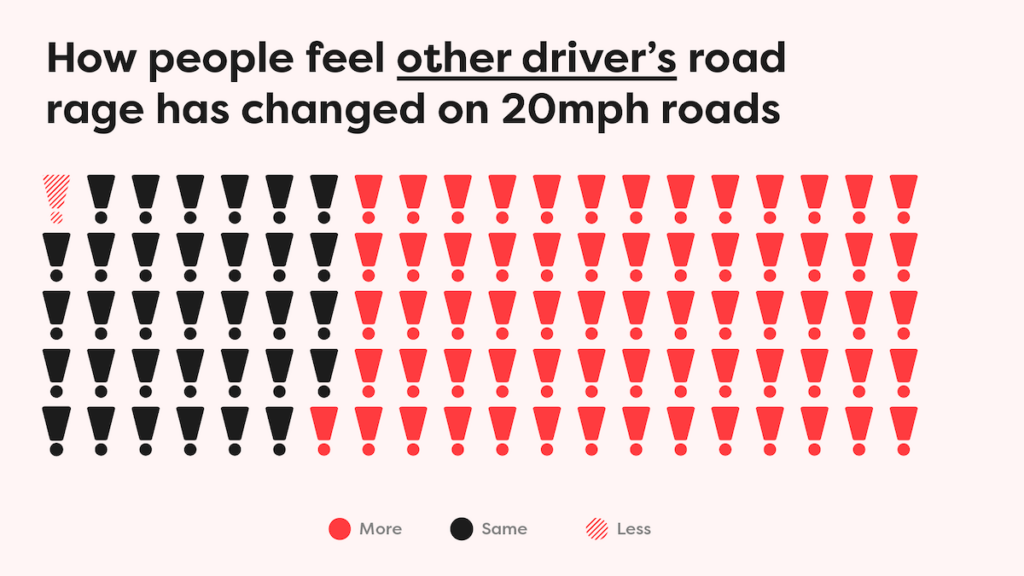
Interestingly, despite 27% of drivers feeling they have more road rage now than in 2023, 66% feel other road users have seen their road rage increase. We can assume the increased road rage is because of the 20mph implementation.
Ensure you have the right car insurance
Sterling has over 30 years’ experience in providing insurance and solutions for the drivers of Northern Ireland. We offer cover for all of life’s journeys, including those involving classic car motorists, van owners and young drivers.
To get a car insurance quote call 0344 381 9990 or request a callback at a time that best suits you.
*Our results are based on an online survey we conducted through the Survey Monkey platform. Out of 1,727 responses we got 1,477 respondents in Wales who qualified to make up our sample data.