
Driving on the right-hand side of the road can be a daunting prospect if you have never done it before. Whether you’re renting a car in Europe or visiting in your own vehicle, there is a lot to get used to.
Understanding how to safely navigate roads while driving on the opposite side is essential. That’s why we’ve put together six tips to help you visit your favourite European countries when behind the wheel.
Research the driving laws for the country you’re visiting
A lot of European countries have different road signs and driving laws from the UK, so it’s important to know the major differences before visiting. Studying up on areas that you plan on seeing will help you get acquainted with their rules before you visit.
Learning a few phrases in the language of the country you are travelling to is also a good idea, as some road signs may have written instructions as opposed to visual signs. Speed limits are in kilometres per hour (km/h), not miles per hour (mph).
It’s also worth noting that some countries in Europe require you to have different items in your vehicle as you pass through.
Research the area on a map before you leave
Before you go on your trip, try to have a rough idea of the area you are visiting. Whether you locate landmarks or earmark where certain attractions are, like the beach, being clued up on the route that you need to take will stand you in good stead.
Some major European cities also require you to have low-emission zone (LEZ) stickers on your vehicle. Destinations that need these include Paris, Berlin and Milan. Failing to display one can result in a fine.
You will also soon discover that many European cities also require ‘vignettes’, which are toll stickers. Many cities have toll roads or electronic systems, meaning you will have to pay to enter certain roads.
A lot of these toll booths still require you to pay in cash, so whilst using your credit/debit card is perfectly acceptable at some, you should always carry some loose change to make sure you can travel on the road you need to.
Make a breakdown plan
Before going on a trip, the last thing you will want to think about is breaking down. But it’s always a good idea to plan for all eventualities, after all, the thought of being stuck on the side of the road in a foreign country can be a terrifying prospect, especially if you are in a rural area with non-English speakers.
Our European breakdown cover is available from £42 a year and provides you with 60 days’ breakdown cover while driving abroad, in any one calendar year.
Sterling can arrange roadside recovery or a reliable home repair service, whether your car or van breaks down in the UK, Europe or further afield.
Drive in the far right-hand lane on a motorway
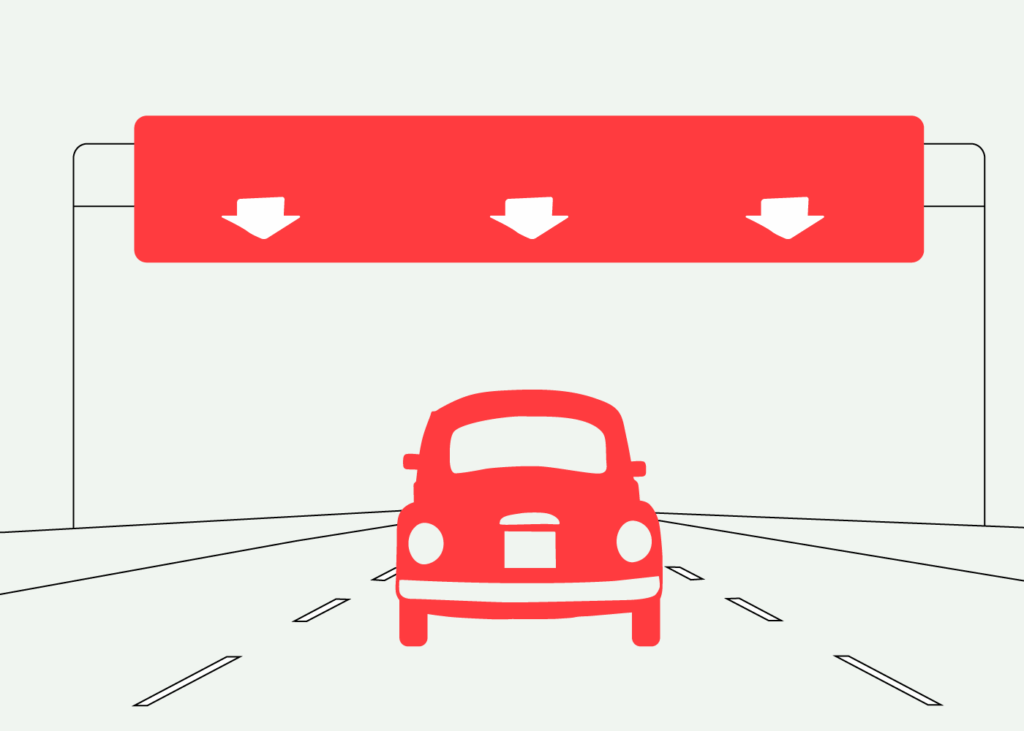
When driving on a motorway in a country that drives on the opposite side of the road, it’s important to understand that all the rules we have in the UK are flipped.
The ‘fast lane’ in the UK is the furthest on the right, but when driving in Europe, you must remember that this will be the furthest lane on the left. When overtaking traffic, you will be manoeuvring past vehicles to your left as you switch lanes.
When you need to pass other drivers, give a left turn signal, safely overtake and move in front.
Away from the motorway, you will also notice that cyclists and pedestrians are approaching from the opposite direction that you are used to.
Roundabouts go counterclockwise
At roundabouts, traffic will flow counterclockwise, meaning you will need to give priority to vehicles coming from the left. As this will all be new to you, it’s best to approach these situations more slowly than you would driving at home.
Take breaks
Driving in a strange area can be exhausting when driving on the left-hand side of the road, but doing so on the opposite side can be even more stress-inducing. Taking regular breaks will help to alleviate any tension and allow you to have a clear mind when you get back behind the wheel.
European car insurance
If you’re planning on driving in Europe, you will need to ensure you have the right European car insurance to give you peace of mind should the worst happen.
Sterling also has a range of car insurance policies for every sort of car, van and campervan, with prices starting from £125 a year and EU cover available. Call us on 0344 381 9990 for a quote or request a callback at a time better suited to you.